
When the Dutch laid claim and established a settlement on “Manhattoes” in the 17th century, the strategic value of the wooded jut between two mighty waterways was already readily apparent. “We found a very agreeable site located within two small prominent hills in the midst of which flowed to the sea a very big river, which was deep within the mouth,” explorer Giovanni da Verrazano had written in 1524.[1]
The prospects for Lagos Island, a water-hemmed city at times branded Africa’s Manhattan, were hazier given its “natural difficulties caused by winds, tides, the rainy season, the rough bar, and [ships] being obliged to anchor for safety far out at sea”—a situation John Whitford observed in 1875 that did not prevent merchants from being nonetheless “alive to its importance” given the lack of protected ports on the West African coast.[2] Lagos Island had for centuries prior been a place of intercoastal but not globally significant trade, a sea-level sandbar severed from the Atlantic by a notoriously wrathful channel until its early nineteenth century rise as a Portuguese slavers’ haunt.
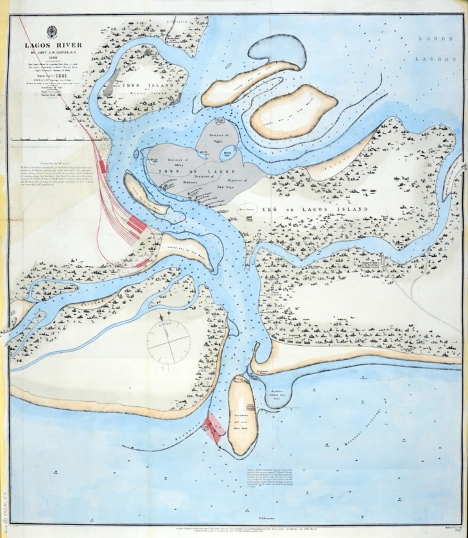
Across the ocean, it was through a fort, taverns, farms, storehouses, townhomes, and churches that a growing cosmopolitan enclave at New Amsterdam clung to and eventually found its prosperous footings in the New World. In Lagos, it was through houses that an initial foothold and then a sturdier leg up out of the soggy landscape was probed as waves of new arrivals carved out a small island kingdom, a vibrant entrepôt, a colony, a capital, and eventually the urban colossus of over 20 million people we know today.
Across a kaleidoscopic diversity of forms and arrangements, houses have maintained their paramount importance in Lagos even as the city has developed a crippling housing shortfall.
The question of housing has now become New Yorkers’ top concern, and with the election of Zohran Mamdani as the city’s Mayor, there is an openness to policies untested by conventional American politics.[3] The concept of social housing has gained momentum in New York and is embraced by Mamdani. Many of its examples and principles come from celebrated European case studies like Vienna where over 60 percent of residents live in municipal housing. A new generation of New Yorkers with Mamdani—an African American from Uganda, the son of an eminent African political science professor, and an undergraduate Africana Studies major himself—as their voice may also be able to find inspiration and insights from the fastest urbanizing continent and its largest city, Lagos.
Looking at Lagos’s historical homes—learning from Lagos on its own terms as the Dutch architect Rem Koolhaas once proposed (but fell short of)[4]—offers ideas and an image in the form of its ilé house typology, I suggest, for seeing past the straitjacket of contemporary housing discourse.
These increasingly urgent conversations about our global housing shortage have often become so narrowed and mired in a myopic way of seeing—as seen in the first New York mayor’s debate[5]—that they completely miss the expansiveness of possibilities and pathways inherent in human inhabitation of a place, of what houses are and can be.
In other words, Lagos holds depths for thinking broader and more boldly about one of the world’s greatest challenges today.[6] The city’s histories and architectures may offer clues and references for the Mamdani generation in imagining social housing policies that break fresh ground.
A City of Upheaval Reinventing Itself Through Ilé
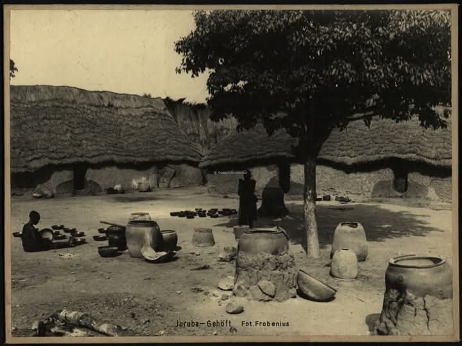
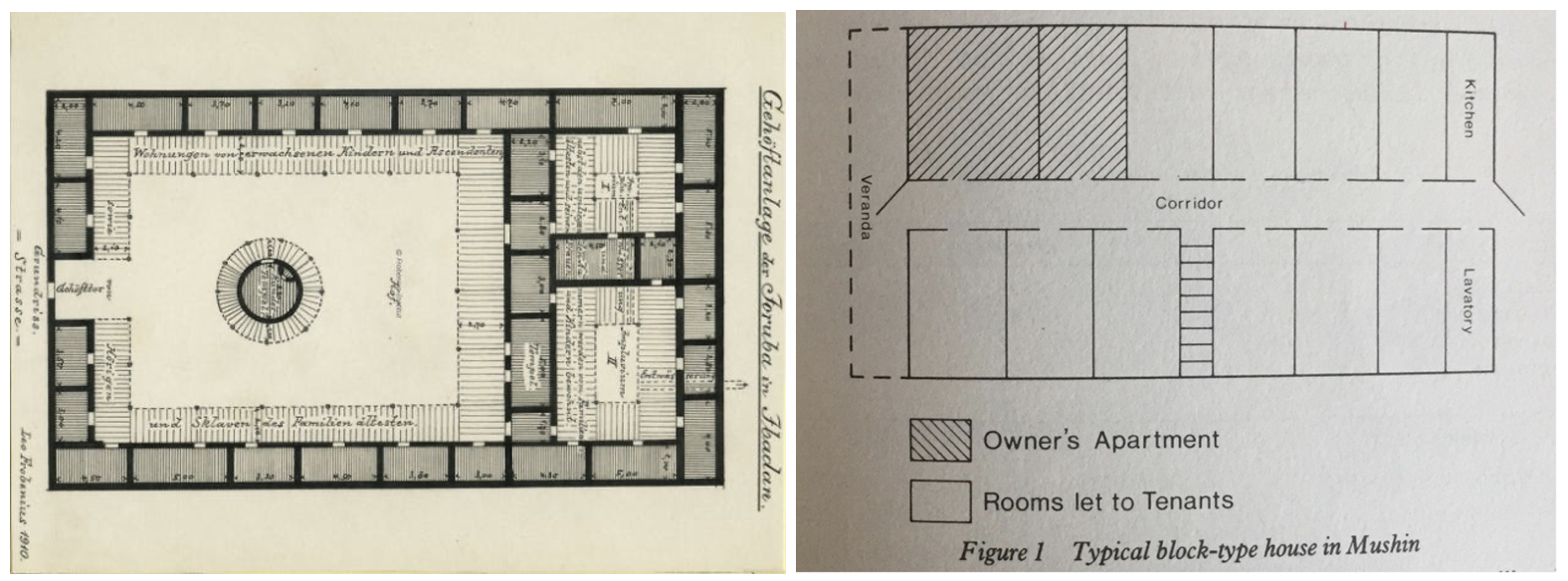
What we can piece together about the early history of Lagos houses comes from oral traditions and travelers’ accounts that describe great earthen compounds containing courtyards that were the hubs of communal life on the island. To be someone—to have rights, privileges, and protections—in the small precolonial Lagos kingdom of Èkó was to belong to a compound and be affiliated with its founding family: ilé in Yoruba refers both a house and a kinship network. Yorubaland was famed for its planned urbanism prototyped on its holy city Ilé-Ifẹ̀ (house of expansion), and houses were its defining infrastructure, their bustling inner yards serving as the spaces where politics, production of wares, and social life were centered.
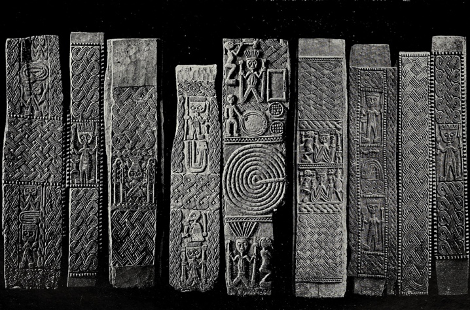
Homes were also works of artistry, crafted over generations with carved pillars and other embellishments that demarcated the prestige and stories of their ilé. The German explorer Leo Frobenius was so impressed by architecture in Yorubaland, writing, “[the] originality of the building … struck me dumb,” that he felt the need to attribute it to a lost Etruscan race via its homes’ impluvium (water collecting) features.[7]
Similar hubris reigned in the 1851 British naval decision to bomb and occupy the island under the claim of ending its slave trade.[8] While British rule was initially precariously carried out by just a handful of colonial agents, the city’s position as a place of exchange of palm oil and other goods between the African interior and Atlantic blossomed. In this “fluorescence period” of cultural mixing and experimentation, African and creole merchants were the city’s scions, building distinctively Lagos-style houses that drew on Brazilian, Middle Eastern, and Victorian influence to transform Yoruba ilé for a new era.
Interiors of these houses incorporated ilé’s familiar spatial scaffolding with rooms splaying off a central passageway and integrated workshops and stores within the home. Smaller houses throughout the city adopted similar floorplans and became diminutive versions of the famous mansions mushrooming above the low-lying cityscape. These homes celebrated their status with flare, their owners annually replastering the exteriors with flower motifs and other fashionable patterns swirling in from the Atlantic in a practice that evoked the Yoruba àṣọ ẹbí culture of dressing one’s kin in matching fabric.
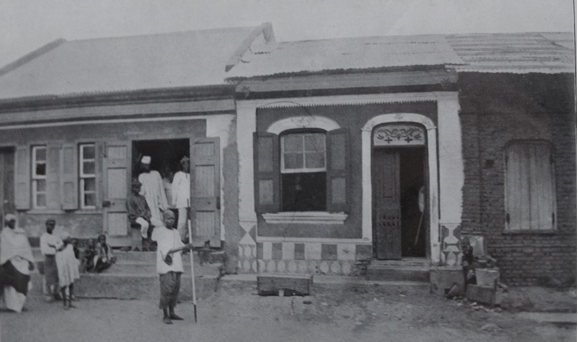

These new forms of ilé became how a Black cosmopolitan class of Yoruba and returned former slaves reclaimed the city as their own, sinking roots into the sandbar and signaling their long-term investment (and thus their creditworthiness within new practices of mortgaging) amidst the ebbs and flows of the city’s waterways and the mercurial tides of commerce they carried.
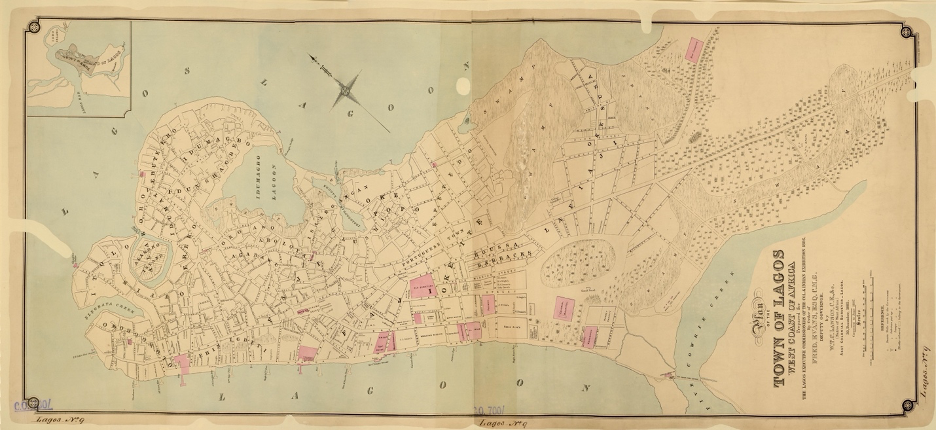
A remarkable 1885 map surveyed by a West African named W.T.G. Lawson includes the names of 125 prominent Lagosians, indicating where they resided on the island. Prominent members like Táíwò Ọlówó—who had risen from an enslaved child to a great merchant with a sprawling multi-courtyard compound in the Faji District[9]—were held to high standards by the community in their roles as landlords and patrons, being expected to use their wealth and status generously and conspicuously to look out for their people. As Táíwò’s 1901 obituary celebrated, “with him money became wealth in the fullest sense of the term,” as he lived up to the expectation to infuse his gains back into the neighborhood and networks that made them possible.
Yet with the turn of the century, this class of homeowners would be kneecapped at every turn by the colonial administration as it refined its ability to wield land and housing as instruments of power. Colonial agents targeted and undercut Black Lagosians who aspired to follow in men like Táíwò’s footsteps by passing impossible housing regulations requiring the use of materials not readily available in the colony and restricting credit along racial lines, driving their mortgages underwater and confiscating their property as a means of expanding and consolidating British rule.
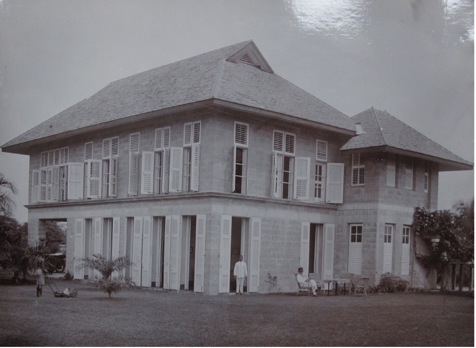
Under imperialism, Lagos planners conceived of houses in blunt terms of power and physical occupation, erecting brick and iron structures to assert colonial officers’ position above African subjects. The hulking waterfront Government House (1896) epitomized this desire to dominate with architecture. To build these estates, British governors seized premier city lots, eventually creating segregated enclaves under the pretext of health policy. Colonial reports portrayed Lagosians’ homes as incubators of disease, writing that Africans’ “mud huts and timber houses … cannot be called houses.”[10] Yet, the archive shows that the Foreign Office’s own studies revealed more mosquitoes lurking in colonial quarters than African.[11] Like so much of colonial planning in Lagos, an aesthetic project was prioritized over actual empirical or historical inquiry.
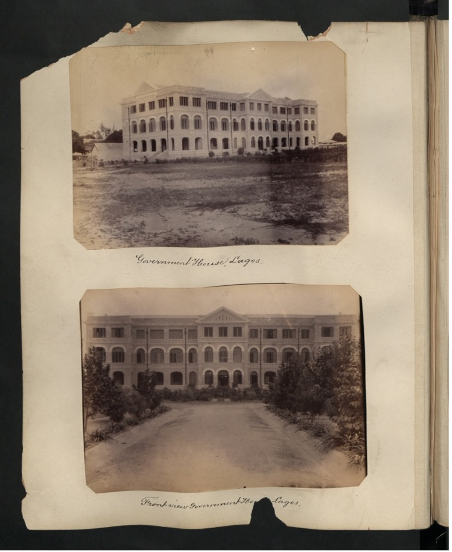
It was on the steps of Government House that the father of Nigerian nationalism, Herbert Macaulay, made his famous 1912 case against British land grabs in Lagos, bemoaning that these schemes were not for the health and development of natives, but part of a system predicated on getting “at the Tin Mines far away yonder” in Nigeria’s interior.[12]
Visions of what a proper colonial city should look like—surveillable with straight streets and uniform structures to facilitate the imperial port’s purpose of efficient extraction—drove housing decisions. Ilé, with their interlocking courtyards, organic materials, and odd angled annexes housing all assortments and comings-and-goings of kin were viewed as impediments to progress.
Bewildered by these arrangements, successive Lagos governors extended housing’s role beyond political and sanitary agendas, turning it into a means of directing and disciplining the city’s labor force. Barracks and small rentals became shelters for the city’s growing working class as Lagos became the capital of amalgamated colonial Nigeria (1916). Those deemed unemployable by the government were left homeless or in precarious dependency on hosts in the African side of the city, creating a new African landlord class who could leverage housing precarity to extract greater demands on their dependents and tenants. Shelter was no longer something taken for granted in Lagos; it had become a tool for organizing and directing resident’s toil toward colonial capitalism’s ends, leading to novel forms of poverty—and their policing by the state—previously not widely known in the city. Slums were emerging and, rather than assisting them, colonial agents fined and harassed their residents.
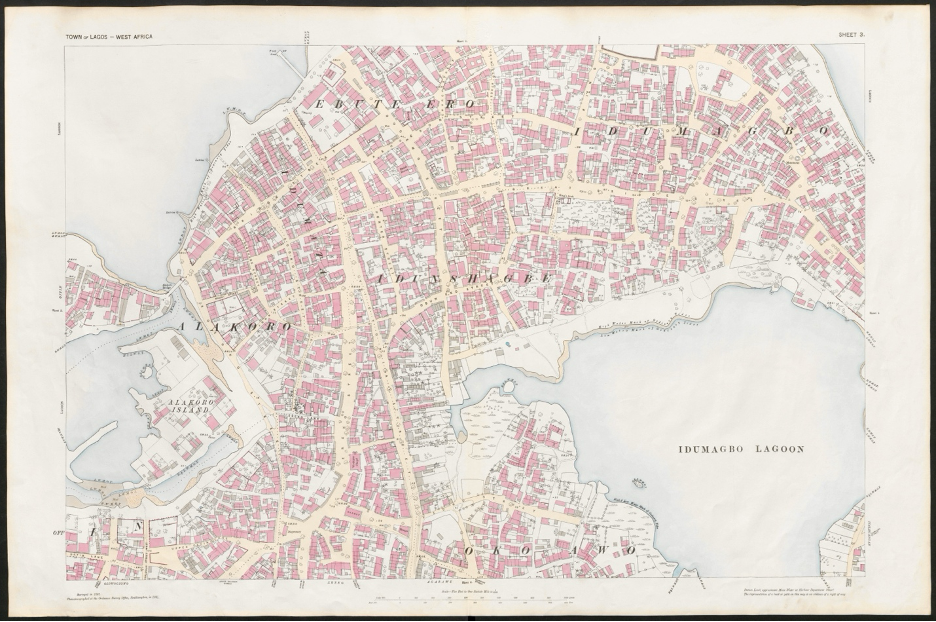
In this environment, houses became symbols of anti-colonial struggle with the African Mail writing of Lagos in 1908, “The natives begin to see that it is [Europeans] who are finding money to build all these fine palaces; … the people look at their own poor little huts alongside the palatial buildings of the European and wonder how long and how far this thing is to go.”
Yet the housing situation deteriorated further in the increasingly congested African sections of the city, as 86 percent of Lagos’s land had been expropriated by the Crown by 1947. This compression of 97 percent of the population into just 14 percent of the city’s area gave British planners new opportunities to recast the deprivation of African housing as justification for its seizure and demolition. In the name of the emerging concept of “development,” postwar officials transformed a century of colonial neglect and coercion on the African side of the city into the rationale for large-scale clearance.
This self-serving gambit reached its crescendo with plans in the 1950s to raze central Lagos without any actual analysis of the history, economics, or dynamic nature of the neighborhood. Thousands of market women marched against the scheme that would destroy the livelihoods and community sustained by the area’s mosaic of ilé. The sociologist Peter Marris’s 1950s surveys of central Lagos provide a counter-history to colonial claims of blight and backwardness, detailing a thriving hub where ilé principles of trust and mutual support had been reimagined to sustain extended social and commercial networks.[13] As a result of these relationships, Marris found that rents were paradoxically lower in the center of the city than elsewhere, as landlords and tenants who had known each other for years calibrated a rate that worked for both parties.
Demolition of central Lagos went forward nonetheless, making way for tall office buildings that constructed an image of a downtown befitting the capital of Britain’s West African crown jewel. Again, Lagos papers called out the game—that on the eve of independence the city was being turned “into a citadel for foreigners whilst the natives will be made to live in the mainland.”[14] Marris went on to document how central Lagos’s former residents suffered declines in their health, social lives, and financial positions in the supposedly superior modern estate where they were relocated on the mainland.

Housing in Lagos grew upward in the form of cement low-rises as the city boomed from one million people in 1965 to five million in 1985. These mass apartments maintained the spatial logics of ilé through the arrangement of rooms along long central hallways. For those who could find a place in these tight-knit and aptly named “face-me-I-face-you” tenements, houses were a lifeboat amidst dizzying change in the postcolonial city. Housing blocks became mutual support communities while a succession of military dictatorships largely neglected the booming city’s municipal functions. Becoming part of these webs of landlord-tenant networks and their intricately defined social obligations became what a 1972 Lagos newspaper described as “a protective jacket” for the city’s residents.[15] These relationships and the city’s exponential population growth further amplified the value of homes, which was a grounded asset amidst the heady and speculative oil boom years after petroleum was discovered in Nigeria.
In the 21st century, Lagos houses have increasingly become financial instruments used to park and clean cash in what has been described as Nigeria’s “vampire” economy of an elite jet-setting class funneling off petroleum rents for private enrichment. Today, despite court injunctions, entire neighborhoods with generations of history and the few remaining Lagos-style houses (like the appallingly lost 200-year-old Ilojo Bar)[16] are being demolished and their residents displaced to make way for fortress-like mansions in gated enclaves disconnected from social and civic life. These forced evictions and a dire shortage of affordable housing are pushing residents and an endless sprawl of newcomers further into the rising waters on the frontlines of climate change.
Today, Lagos has a housing deficiency well over 5 million units, making cities like New York’s housing crisis appear manageable by comparison.[17]
A Lifeless Policy Playbook
The conventional prescription for Lagos and other cities with spiraling housing shortages is simply “to build more housing,” to find ways to unleash markets forces to generate new supply and—as the logic goes—to deflate housing costs. But Lagos is pure market, a hyper-capitalist frontier where new units should be popping up to satisfy immense demand. Yet this is not happening. Yes, land titling can be difficult in the legally layered city, but it is not impossible, and ọmọ onílẹ̀ (descendants of original landholders) with secure rights should have little problem building more housing and collecting further rents.
The problem is that the market is working: why would these landowners build mass housing and collect the drips of small leases when they can build manors for the city’s elite that command exponentially higher sums in one fell swoop? Lagos has become a legendarily stratified city with wealth disparities as pronounced as anywhere in the world. In 2016 it was calculated that luxury properties in Lagos ranged from 80 million to 1.3 billion Naira, whereas the average Lagosian earned far less than 120,000 naira per year.[18] The profit margins explain why the city’s developers focus almost exclusively on high-end properties. As Adéwálé Májà-Pearce has written, in contemporary Lagos, there is an overriding “interest in using what land can be had to house the elite.”[19]

Economists are starting to appreciate the ways in which this cliff between the richest and the rest skews markets in perverse ways. Disney World offers a case study in how the economic incentives are clear: targeting the ultrarich and leaving everyone else behind is just profitable business today.[20] Professional sports are seeing a similar shift towards targeting customers able to pay for premium experiences.[21] Washington, DC provides another datapoint against the “unleash supply” mantra of abundance[22]: the city granted private developers billions in subsidies since 2002 which created new units, yet “rents during this same timeframe increased roughly 55 percent” as developers built high end apartments almost exclusively, often gutting or demolishing affordable homes in the process.[23]
When housing becomes a luxury commodity out of reach to most, a city’s social fabric begins to breakdown. Houses—in all their myriads of forms—have historically been vessels for sustaining kinship bonds and allowing those ties to be nurtured, reproduced, and passed down. When that hearth is out of reach, a crisis of social reproduction occurs. As Nomusa Makhubu describes, Lagos’s film industry, Nollywood, is resplendent with films telling this tale of sterile mansions stocked with luxury items but no familial life. Frequently the movie plots revolve around uncovering a secret occult shrine that has possessed the house and its would-be patriarch.[24] What would it mean to exorcise limiting concepts of housing in Lagos writ large?
In place of houses becoming objects of capitalist possession unattached from the sociological cloth of cities, how do we reimagine houses and housing not only in Lagos but globally? Lagos’s historical ilé forms and their stubbornly resilient remnants offer a starting point to explore the wide spectrum of social and material architectures that can form housing and the possibilities to which secure housing gives life.
Learning from Lagos’s Legacy of Ilé
In Lagos, it is common to come upon houses with the hand-painted sign: “this house is not for sale.” This arises because con artists frequently sell other people’s homes to unsuspecting buyers. The notion of a home being sold off through a con echoes the discourse surrounding the flight of the country’s oil resources, from which the majority of the citizens do not benefit. The “crisis” of the home is symbolic of the “crisis” of the nation. As a visual metaphor, the home or the house is correlated to deception, illusion, or the ruse through which the experience of place is inseparable from image and imagination.
—Nomusa Makhubu, “This House Is Not for Sale”
In all their iterations and adaptations, ilé’s shared courtyards and communal spaces have meant stability and continuity, while also serving as sites of creativity and hospitality where reciprocal obligations of caretaking and custodianship have trumped possessive extraction. In other words, ilé are social housing and are what made Lagos possible as a city. Even across a century of colonial and postcolonial upheaval, housing animated by these underlying concepts have helped Lagosians remain in place and resist the imperial and financial forces that would dislodge them. Ilé remain a powerful architectural fabric in the city despite immense and intensifying pressure to displace Lagosians and reduce their homes to luxury commodities.
Can ilé-derived house types be preserved and creatively expanded to make up more of Lagos’s housing? In a city where 80 percent of high-end house buyers do not reside in the city, creating laws and incentives that reward the ilé model and enact costs on anti-social housing developments would be a place to start. For this to happen, the city needs designers, planners, and policymakers who are willing to look beyond broken supply-side economics and—with historical homes as muse—look at the fullness of possibilities of what housing could become.
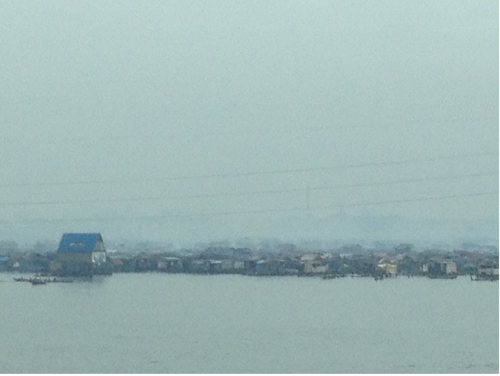
Here would be the place to neatly drop in the most cited Lagosian architectural project of the past several years—the royal blue Makoko floating school—as an uplifting prototype for a path forward. Yet, as Allyn Gaestel chronicles in her article, “Things Fall Apart,” the now iconic A-frame won international accolades while it sat falling into disrepair, rarely holding classes because toilets and blackboards were not included in the design and parents wisely feared the structure’s violent swaying. [25]A week after it won the Venice Biennale’s Silver Lion Award, it splintered to pieces in a storm. Climate change and a century of a neighborhood’s marginalization cannot be conquered by a slick design, no matter how brilliant.
If there is a Lagos “architecture” to look in search of the spirit of ilé, Justice and Power Initiatives (JEI), an organization that endlessly advocates and builds coalitions for the city’s slum dwellers is a better place to start. These residents are constantly under threat of violent state-sponsored evictions yet have built an organization in JEI to sustain a movement and demand attention and dignity.[26] Unfortunately, JEI’s work is not nearly as memetic as Makoko floating school.
Back in Manhattan and the surrounding boroughs, a growing coalition of housing advocates, architects, and legislators is advancing a renewed vision for social housing—one that treats homes as public goods rather than speculative assets. Proposals such as the creation of a Social Housing Development Authority would empower the city or state to build, acquire, and rehabilitate permanently affordable housing under democratic governance, ensuring residents—not private investors—shape how their communities evolve. This emerging framework, echoed in campaigns like Housing Justice for All and Representative Ocasio-Cortez’s call to recognize housing as a human right, seeks to replace extractive development with models that are inclusive, sustainable, and oriented toward long-term social value. Because housing is not just advocacy and socio-economic policy, but architecture, these campaigns will need compelling images and cultural references to succeed—particularly in the extreme visuality that our politics—as seen in the nearly cinematic campaign of Mamdani—now inhabits.
Zohran Mamdani’s winning campaign put affordability and housing at its core, explicitly endorsing the creation of a Social Housing Development Authority to finance public and cooperative housing through state capital. Now that Mamdani has been sworn in, there is hope that he can lead a movement to think bigger in embracing novel housing models. Lagos and its legacy of ilé offer inspiration where housing is inseparable from community, craftsmanship, and mutual care. Drawing on this model and its historical images, it is possible to imagine housing not merely as shelter but as social infrastructure for cities like New York—an opening to rebuild trust and belonging for the next generation.
[1] “Man in the News: He Came Here in 1524: Giovanni da Verrazano,” New York Times, November 21, 1964.
[2] John Whitford, Trading Life in Western and Central Africa (Liverpool: The “Porcupine” Office, 1877), 86.
[3] Community Service Society of New York, “Affordable Housing and Access to Healthcare Are Top Concerns of NYC Residents,” press release, December 14, 2023, Community Service Society News, https://www.cssny.org/news/entry/affordable-housing-and-access-to-healthcare-are-top-concerns-of-nyc-residen.
[4] Mark Duerksen, “The Koolhass Effect: Hot Air over Lagos,” Johannesburg Workshop in Theory and Criticism (JWTC), https://jwtc.org.za/test/mark_duerksen.htm.
[5] Housing New York: The Debate Had a Lot of Housing Talk, but the Next Mayor Needs Bigger Ideas,” New York Times, October 23, 2025, https://www.nytimes.com/2025/10/23/opinion/housing-new-york-mayor-cuomo-mamdani.html.
[6] Mark Duerksen, “Lagoon: Hidden Depths to Housing Schemes across Independence in Lagos, Nigeria,” Journal of West African History 7, no. 2 (2021): 49–90, https://scholarlypublishingcollective.org/msup/jwah/article-abstract/7/2/49/294077/LagoonHidden-Depths-to-Housing-Schemes-across
[7] Leo Frobenius, The Voice of Africa, vol. 1 (London: Hutchinson, 1913), https://library.si.edu/digital-library/book/voiceofafricabei01frob
[8] The Crown did not officially outlaw domestic slavery in the Southern Nigerian Protectorate until 1916.
[9] While Táíwò held slaves himself, he was representative of the ways that land grants and the establishment of a house became an avenue for late nineteenth century enslaved people in Lagos to liberate themselves from systems of bondage that the British were reluctant to abolish out of fear of dislocating production.
[10] As quoted in Stephanie Newell, Histories of Dirt: Media and Urban Life in Colonial and Postcolonial Lagos (Durham, NC: Duke University Press, 2020).
[11] “Reports, &c., From Drs. Stephens and Christophers, West Coast of Africa,” in Reports to the Malaria Committee of the Royal Society, 3rd ser. (London: Harrison and Sons, St. Martin’s Lane, 1900).
[12] Herbert Macaulay, The Lagos Land Question (Lagos: Tika-Tore, 1912).
[13] Peter Marris, Family and Social Change in an Africa City: A Study of Rehousing in Lagos (Evanston, IL: Northwestern University Press, 1962).
[14] “Lagos Slum Scheme: For Whose Benefit?” Daily Service, November 21, 1955.
[15] Quoted in Sandra Barnes, Patrons and Power: Creating a Political Community in Metropolitan Lagos (Manchester: Manchester University Press, 1986), 78.
[16] Stephanie Ohumu, “How to Kill a Monument: The Demolition of Ilojo Bar,” This Is Africa, September 21, 2016, https://thisisafrica.me/arts-and-culture/kill-monument-demolition-ilojo-bar/
[17] Lookman Oshodi, “Housing Situation in Lagos, Nigeria,” Lookman Oshodi: International Development, Urban Infrastructure and Governance (blog), November 24, 2010, https://oshlookman.wordpress.com/2010/11/24/housing-situation-in-lagos-nigeria/
[18] Estate Intel, The State of the Lagos Housing Market Vol. 2 (2016), https://estateintel.com/reports/the-state-of-the-lagos-housing
[19] Adéwálé Májà-Pearce, “Nothing without Water,” Places Journal, October 2023, https://placesjournal.org/article/lagos-nigeria-and-climate-crisis/
[20] Daniel Currell, “Disney Is the Happiest Place on Earth, if You Can Afford It,” New York Times, August 28, 2025, https://www.nytimes.com/2025/08/28/opinion/disney-world-economy-middle-class-rich.html
[21] Kevin Draper, “How the NBA and MLB Lost Their Fans,” New York Times, June 16, 2025, https://www.nytimes.com/2025/06/16/opinion/sports-nba-mlb-leagues-streaming-fan.html
[22] Steffen Wetzstein, “Toward Affordable Cities? Critically Exploring the Market-Based Housing Supply Policy Proposition,” Housing Policy Debate 32, no. 3 (2022): 506–532, https://doi.org/10.1080/10511482.2021.1871932
[23] The Center for Social Housing and Public Investment, “Part 2: The Economics of Speculation, Demolition and Displacement—A Worsening of Washington DC’s Affordable Housing Crisis,” Reports, Social Housing Center, https://www.socialhousingcenter.org/reports-2
[24] Nomusa Makhubu, “‘This House Is Not for Sale’: Nollywood’s Spatial Politics and Concepts of ‘Home’ in Zina Saro-Wiwa’s Art,” African Arts 49 (2016): 58–69.
[25] Allyn Gaestel, “Things Fall Apart,” Atavist Magazine, no. 76 (2018), https://magazine.atavist.com/things-fall-apart-makoko-floating-school
[26] “Nigerians Try to Make Sense of What Was Lost in the Makoko Fishing Village Demolition,” New York Times, January 16, 2026, https://www.nytimes.com/2026/01/16/world/africa/nigeria-makoko-fishing-village-destroyed.html
 Arcade Africa
